


Lisa McMican Ryle
Founder & Engineer
We Started From the Other End
Most children's clothing is designed to be put on. Almost none of it is designed to be opened.
That is a small distinction until your child has a feeding tube or a central line. Then it is the difference between reaching a site in ten seconds and undressing a sleeping baby at 3 a.m.
What already existed was access added to a garment that had already been designed. We started at the other end: where the line leaves the body, where it travels, and where a caregiver's hands need to be. The garment came second.
These are textiles, not medical devices. No prescription, no prior authorization. A family can simply buy one, and a child can wear it everywhere life happens: the hospital, the living room, the playground, the party.
Read our story · See exactly how it works
— Lisa

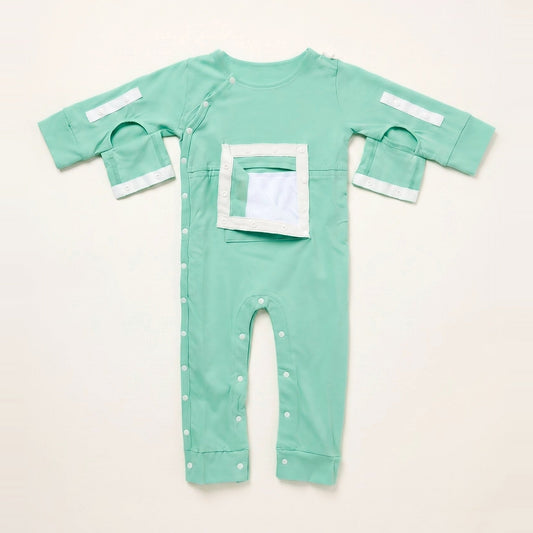
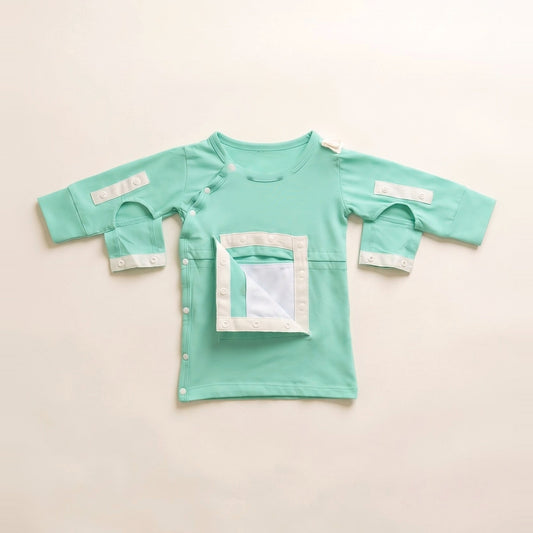
It opens completely flat
Most children's clothes go on over the head, or the arms thread through the sleeves first. Neither works well when there is a tube or a line involved.
Lay this one open, lay your child down on top of it, bring the sides up and fasten. Nothing passes over the head.

The pocket that holds the line or tube
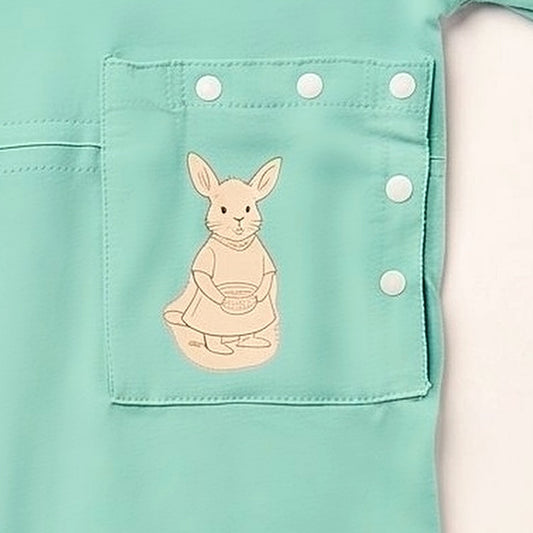
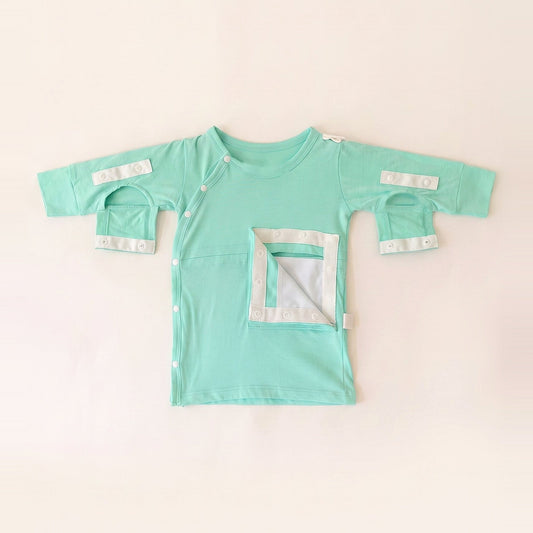
The PediaPouch™ keeps lines or tubing gathered against the body, under the fabric, out of reach. Snap flaps open for feeds and site checks without a full change of clothes — and the moisture-resistant lining wipes out instead of soaking through.

And the sleeve opens too
An arm line is the other thing you have to reach, and most adaptive clothing forgets it. Dual Arm Access™ opens along the inner bend of each sleeve, so an arm line can be reached without pushing a sleeve up over a dressing — a peripheral IV, a blood draw, a pulse ox probe. Every garment has it, whichever line you are managing.

Two systems, four garments
Which one fits your child
One decision: where does the line come out.
TubeWear™ — for G, J and GJ tubes. The line exits at the abdomen, and the PediaPouch™ sits over the tube site. Gown Newborn–12M, Bodysuit 6M–5T.
LineWear™ — for Broviac, Hickman and other tunneled central lines. The line exits at the chest, and the PediaPouch™ sits at the exit site. Gown Newborn–12M, Bodysuit 6M–5T.
Everything else is identical — the lined pouch, RoutePoints™ at the shoulder and lower back, Dual Arm Access™ on both sleeves. Calm Mint Edition and Sky Lullaby Edition.
Shop TubeWear™ and LineWear™
-
LineWear™ Bodysuit — Central Line Clothing, 6M to 5T
Regular price $59.00 USDRegular price -
LineWear™ Gown — Central Line Clothing, Newborn to 12M
Regular price $59.00 USDRegular price -
TubeWear™ Bodysuit — G-Tube Clothing, 6M to 5T
Regular price $59.00 USDRegular price -
TubeWear™ Gown — G-Tube Clothing, Newborn to 12M
Regular price $59.00 USDRegular price




From the PediaPouch™ Journal
View all
LOVED BY CHILDREN, TRUSTED BY CAREGIVERS
Elaroo™, a Symbol of Guardianship
A kangaroo carries her young in a pouch. So does every garment we make. You will find Elaroo™ on the PediaPouch™ of every one.
She began as a character in a story about a child who carried something, and who was carried in return.